This study investigated the process behaviour and filler transition characteristics in aluminium alloy LF-LDED, where an figure-eight oscillating laser heat source was used to establish the initial molten pool and precisely control the pool width. A GTA heat source was used to pre-melt the tip of the aluminium alloy wire, producing liquid metal that can be stably fed into the molten pool. The effects of heat source spacing-laser to wire distance configuration, GTA current, oscillation amplitude, and wire feed speed on process behaviour-are revealed and discussed. The main conclusions are as follows.
【1】The spacing of the heat source is a key parameter for achieving stable LF-LDED deposition. If the heat source spacing is too large (>5 mm), it will result in a longer transition time for the liquid aluminium alloy to reach the molten pool, causing the deposition layer to form humps. However, changes in the distance between the laser and the wire have a relatively small effect on the stability of the deposition process.
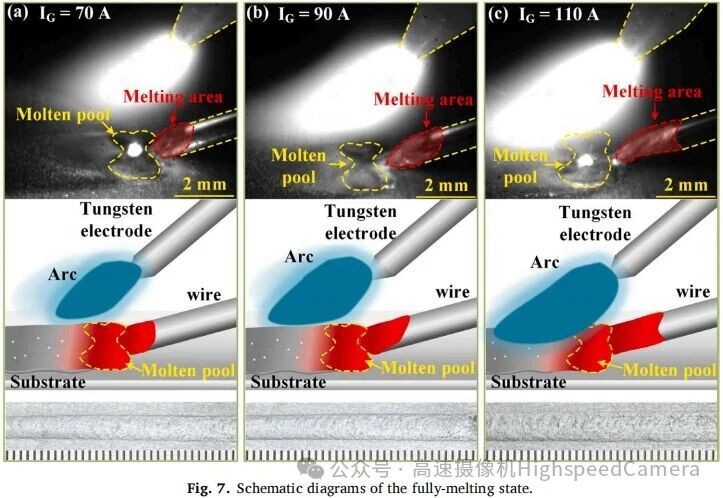
【2】The LF-LDED process has two modes: liquid bridge transition mode and droplet transition mode. The state of wire melting can be divided into semi-melted and fully melted states. When the current is low (I = 30-70A), the wire is in a semi-melted state. The upper part of the wire tip melts into liquid metal while the lower part remains solid, providing stable guidance for the liquid metal and forming a liquid bridge transition. When the current is high (>90A), the wire is fully melted, with the tip completely molten, forming a droplet transition.
【3】In the LF-LDED system, the geometric feature control strategy of the deposition layer can coordinate the swing amplitude and wire feeding speed, achieving precise independent control of layer width and layer height.
【4】The maximum deposition rate of LF-LDED is 1.215 kg/h, which is 2.9 times that of O-LDED. Compared with traditional wire-based LDED, LF-LDED can greatly improve laser efficiency, achieving high-efficiency and high-quality deposition. However, the deposition rate of LF-LDED still lags behind that of WAAM.
【5】LF-LDED can achieve multi-layer deposition of aluminium alloys, showing great potential in the rapid manufacturing of aluminium alloy components. However, as the number of deposited layers increases, defects such as reduced layer height and tail collapse appear in the components, indicating that the multi-layer deposition process of this method needs further optimisation.